
Smoke Management in Large Open Spaces
From atria and malls to stadiums, transit hubs, and large industrial facilities, we design and engineer smoke management systems that maintain tenable conditions for occupants and provide safe access for firefighters during emergencies.
Our designs comply with local Civil Defense requirements, NFPA 92, and ASHRAE standards, ensuring effective control of smoke movement and pressure differentials. Each system is fully integrated with HVAC and building automation systems, delivering coordinated, performance-based solutions that optimize both safety and operational efficiency.
Our scope includes
Design Fire Scenarios
We define design fires, calculate critical smoke layer heights, and develop smoke reservoir layouts in coordination with architectural design.
Empirical Calculations
We perform plume, balcony spill, and window plume analyses to determine spill edge velocities and balance make-up air requirements.
CFD and Multizone Modeling
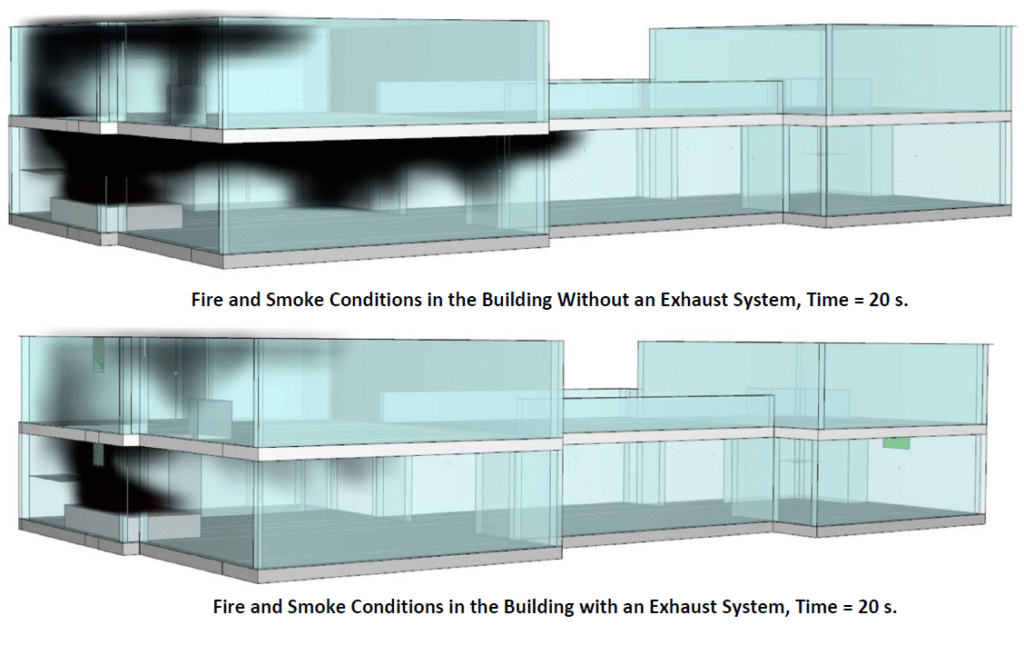
We use FDS/PyroSim to model smoke layer descent, ambient temperature profiles, radiant heat flux, and air velocity fields. CONTAM simulations assess pressure networks, stack effects, and wind influences to ensure system stability under real conditions.
Fan Sizing and Selection
We size and select fans based on exhaust and make-up air rates, temperature classifications, duty/standby configurations, and specific fan power (SFP). We define electrical loads, VFD control requirements, and acoustic and vibration performance criteria.
Flow Strategies
We design flow control strategies to prevent plug-holing, manage opposed-airflow corridors, and optimize jet and impulse fan layouts where required.
Controls and Integration
We develop sequences of operation, Firefighter’s Smoke Control Station (FSCS) interfaces, and interlocks with alarm, suppression, and HVAC systems, including detailed testing and commissioning plans.
Deliverables
We provide a complete documentation package that includes the smoke management strategy report, calculation sheets, fan schedules, CFD and CONTAM outputs, design drawings, control logic diagrams, AHJ submission documents, and commissioning support.